
Updated by
The Vigilo editorial team writes practical, source-checked guides for MedTech professionals in regulatory affairs, quality and clinical roles across Europe.
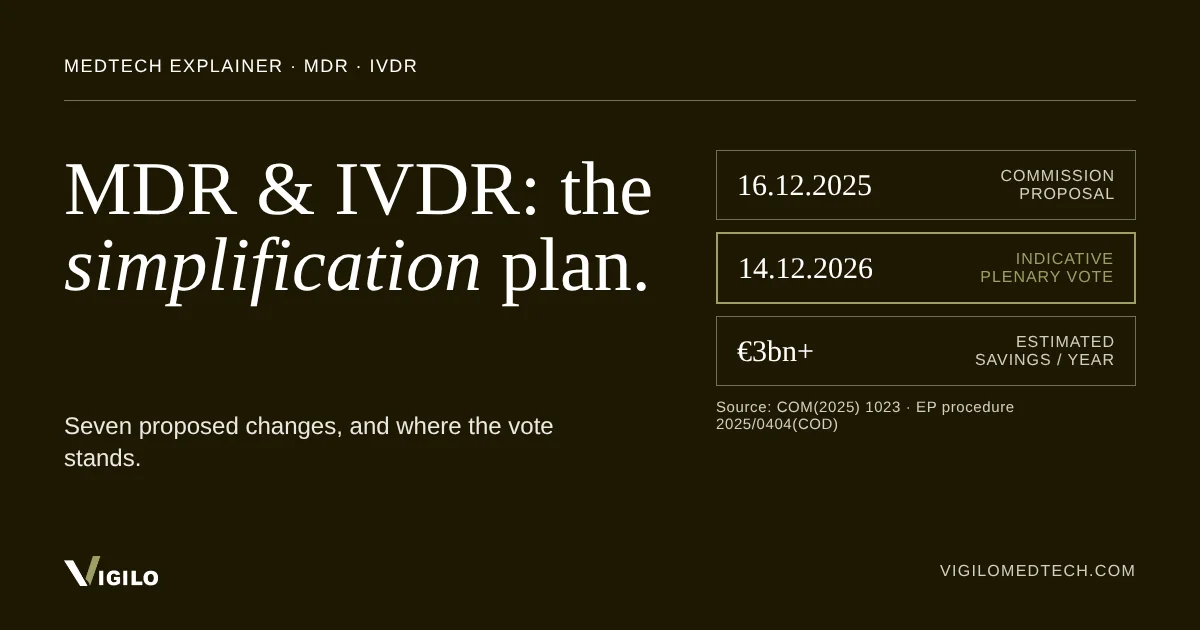
In short: in December 2025 the European Commission proposed a targeted revision of the EU rules for medical devices (MDR) and in vitro diagnostics (IVDR). It would end the five-year expiry of certificates, lower the risk class of some devices, accept more non-clinical evidence and lighten several administrative duties. The Commission puts the savings at more than €3 billion a year. Nothing has been adopted yet: as of 13 November 2026, the European Parliament's lead committee has not voted. Until a final text is published, the current MDR and IVDR apply unchanged.
This article is for anyone in MedTech who wants to understand what is on the table without reading the 100-page proposal: regulatory affairs, quality, clinical, product and business teams.
Why the EU wants to change the rules
The MDR (Regulation (EU) 2017/745) and the IVDR (Regulation (EU) 2017/746) replaced the old Directives with stricter requirements for evidence, notified bodies and traceability. Applying them has proved slow and costly. The deadlines for moving older devices to the MDR have already been extended: depending on the device, the MDR transition now ends on 31 December 2027 or on 31 December 2028.
The Commission describes its proposal as a way to make the framework "leaner and more cost-effective", while keeping patient safety. It notes that small and medium-sized enterprises make up around 90% of the medical device industry, and that the EU market was worth roughly €170 billion in 2024.
Seven proposed changes, in plain terms
1. Certificates would no longer expire after five years
Today a notified body certificate is valid for at most five years. The manufacturer must then go through recertification. The proposal removes this maximum validity. Instead, notified bodies would carry out periodic reviews while the certificate is valid, with a frequency proportionate to the risk of the device.
2. Some devices would move to a lower risk class
The risk class of a device decides how much scrutiny it gets. The proposal adapts some classification rules in Annex VIII of the MDR. According to the Commission, this would give lower risk classes to certain devices, such as reusable surgical instruments, accessories to active implantable devices and software.
3. More room for non-clinical evidence
Under the MDR, safety and performance are mainly shown with clinical data. The proposal widens the cases where a manufacturer can rely on non-clinical data alone (MDR Article 61). It also promotes "New Approach Methodologies", such as in silico testing, meaning computer simulations of how a device behaves.
4. A single definition for "well-established technologies"
The MDR currently lists specific device types that benefit from lighter rules, in Articles 18(3), 52(4) and 61(6)(b). The proposal replaces these lists with one general definition of a "well-established technology device".
5. Lighter rules for the person responsible for regulatory compliance
Every manufacturer must name a person responsible for regulatory compliance, the PRRC (MDR Article 15). Today the law sets detailed qualifications: a relevant degree plus one year of experience, or four years of experience. Small companies that use an external PRRC must have that person "permanently and continuously" at their disposal. The proposal removes the detailed qualification requirements and asks only that an external PRRC be "available".
6. No more notified body certificate for relabelling and repackaging
Distributors and importers that relabel or repackage devices currently need a notified body certificate and must give prior notice. The proposal removes both requirements.
7. EU-set fees, with possible reductions for SMEs
The proposal would allow the Commission to set fees for certain activities, such as the assessment and monitoring of notified bodies, with the possibility of reduced rates for SMEs.
The proposal contains other changes, for example on reporting timelines and digital documentation. We list here only the points we checked in the Commission's own text.
What it would save
The Commission estimates that the combined, quantifiable impact of the simplification measures would reach more than €3 billion per year. This is the Commission's own impact estimate, not an independent study. It also proposes a new evaluation of the MDR and IVDR five years after the changes take effect.
Where it stands (13 November 2026)
| Date | Step |
|---|---|
| 16 Dec 2025 | The Commission publishes its proposal, COM(2025) 1023, procedure 2025/0404(COD). |
| 25 Mar 2026 | The proposal is formally referred to the European Parliament's Public Health committee (SANT). |
| 30 Jun 2026 | The committee's draft report is published. Amendments follow in July. |
| 14 Dec 2026 | Indicative date for a first-reading vote in plenary, according to the Parliament's Legislative Observatory. The committee vote has not taken place yet. |
| Next | The Council of the EU (the member states) must agree its own position. Parliament and Council then negotiate a single text, which is published in the Official Journal. |
Parliament can also amend the proposal. Its rapporteur's draft report suggests changes of its own, so the final text may differ from the Commission's version described above.
What this means for you today
- Nothing changes yet. Certificates still expire, classification rules still apply, and PRRC requirements stay as they are until a new regulation is published and applies.
- Keep your MDR transition plans. The 2027 and 2028 transition deadlines are current law. Do not delay a certification project on the assumption that the proposal will pass in its current form.
- Watch three points. Certificate validity, the classification of software and the PRRC rules could change how you plan recertification, budget notified body work and staff your regulatory team.
- Follow the votes. The Parliament committee vote and the Council position are the next signals. We will cover them on Vigilo.
Looking for your next role in regulatory affairs, quality or clinical? Browse current openings across Europe on Vigilo.
General information, not regulatory advice. This article describes a legislative proposal, not adopted law. Countries outside the EU system, such as Switzerland and the United Kingdom, decide separately how to respond to EU changes.
Sources
- European Commission, Proposal for a Regulation amending Regulations (EU) 2017/745 and (EU) 2017/746 as regards simplifying and reducing the burden of the rules on medical devices and in vitro diagnostic medical devices, COM(2025) 1023 final, Strasbourg, 16.12.2025, explanatory memorandum. PDF.
- European Parliament, Legislative Observatory, procedure file 2025/0404(COD). OEIL. Read on 10 November 2026.
- Regulation (EU) 2017/745 on medical devices, Article 15, consolidated version of 9 July 2024. EUR-Lex.
- European Commission and EUR-Lex content © European Union, reused under Commission Decision 2011/833/EU.
Related posts
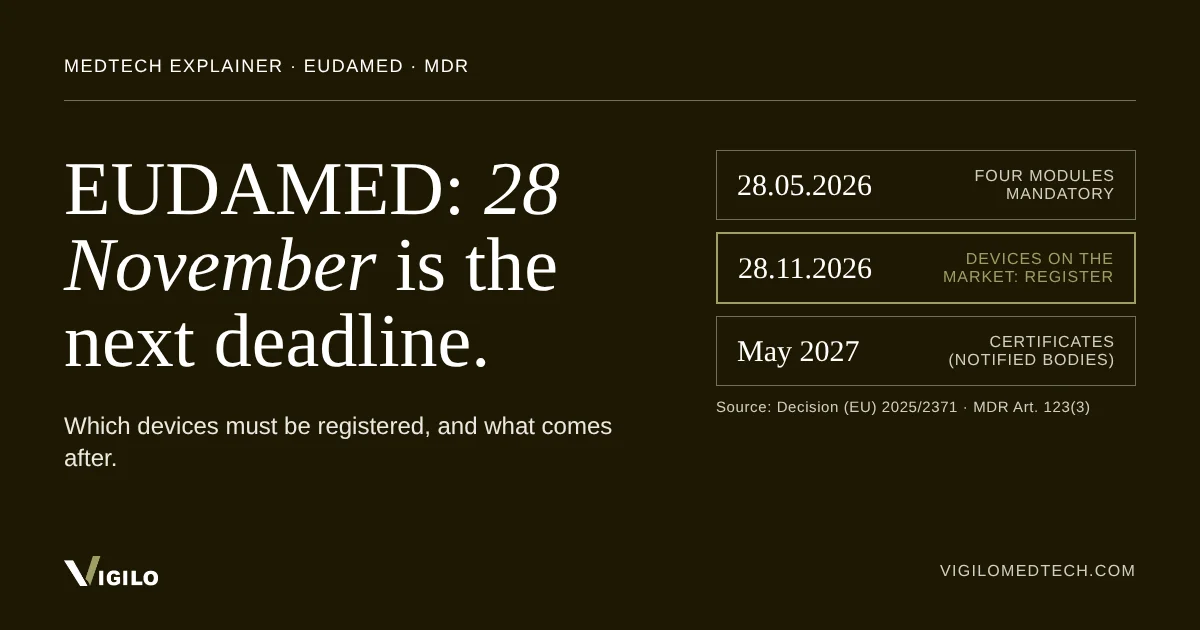
Four EUDAMED modules have been mandatory since 28 May 2026. If you still place units of a device on the EU market, legacy devices included, it must be registered by 28 November 2026. Who must do what, with the legal references.

The code for your product type is only half the story. How to check that a notified body is really designated for your device, with the full MDS and MDT code lists and a checklist.