
Updated by
The Vigilo editorial team writes practical, source-checked guides for MedTech professionals in regulatory affairs, quality and clinical roles across Europe.
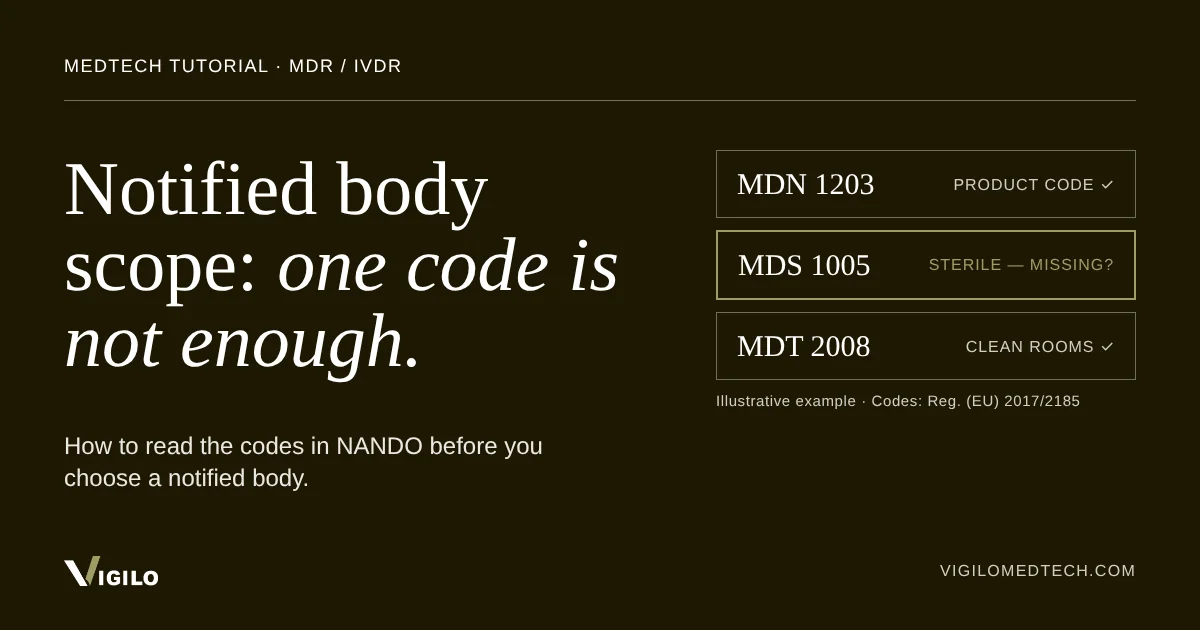
In short: a notified body is only allowed to certify the devices its designation covers. That scope is written in codes. The code for your type of product is only half of it. Your device may also need "horizontal" codes, for example for being sterile, running software or containing a medicinal substance. Before you contact a notified body, list every code your device needs. Then check in NANDO, the European Commission's register, that the body holds all of them.
This guide is for anyone in MedTech who has to pick a notified body or check one: regulatory affairs, quality, product managers and founders. No prior knowledge of the codes is needed.
What a notified body is, and when you need one
A notified body is an independent organisation that an EU country has designated to assess whether certain medical devices meet EU rules. Under the Medical Devices Regulation (MDR, Regulation (EU) 2017/745) and the In Vitro Diagnostic Medical Devices Regulation (IVDR, Regulation (EU) 2017/746), most devices need one before they can be placed on the EU market.
The main exceptions are the lowest-risk products. These are class I medical devices that are not sterile, have no measuring function and are not reusable surgical instruments, and class A in vitro diagnostic devices that are not sterile. Their manufacturers can declare conformity themselves. For everything else, choosing the right notified body is one of the first serious decisions in a project.
How a notified body's scope is defined
When an EU country designates a notified body, it must state precisely which conformity assessment activities and which types of devices the body may assess. It does this with a common list of codes, set out in Commission Implementing Regulation (EU) 2017/2185. Annex I covers the MDR and Annex II covers the IVDR.
Each annex has two families of codes.
1. Codes for the design and intended purpose of the device
- MDA codes cover active devices, meaning devices that depend on an energy source such as electricity. Examples include active implantable devices, imaging and monitoring devices, and active therapeutic devices. Standalone software has its own code here: MDA 0315, "Software".
- MDN codes cover non-active devices. Examples include MDN 1102, "Non-active osteo- and orthopaedic implants", MDN 1203, "Non-active non-implantable guide catheters, balloon catheters, guidewires, introducers, filters, and related tools", and MDN 1204, "Non-active non-implantable devices for wound and skin care".
2. Horizontal codes
These apply across product types. The MDS codes cover devices with specific characteristics, and the MDT codes cover devices for which specific technologies or processes are used.
| Code | Devices with specific characteristics (MDR) |
|---|---|
| MDS 1001 | Devices incorporating medicinal substances |
| MDS 1002 | Devices manufactured utilising tissues or cells of human origin, or their derivatives |
| MDS 1003 | Devices manufactured utilising tissues or cells of animal origin, or their derivatives |
| MDS 1004 | Devices which are also machinery (Directive 2006/42/EC) |
| MDS 1005 | Devices in sterile condition |
| MDS 1006 | Reusable surgical instruments |
| MDS 1007 | Devices incorporating or consisting of nanomaterial |
| MDS 1008 | Devices utilising biologically active coatings and/or materials or being wholly or mainly absorbed or locally dispersed in the human body or intended to undergo a chemical change in the body |
| MDS 1009 | Devices incorporating software/utilising software/controlled by software, including devices intended for controlling, monitoring or directly influencing the performance of active or active implantable devices |
| MDS 1010 | Devices with a measuring function |
| MDS 1011 | Devices in systems or procedure packs |
| MDS 1012 | Products without an intended medical purpose listed in Annex XVI to the MDR |
| MDS 1013 | Class III custom-made implantable devices |
| MDS 1014 | Devices incorporating as an integral part an in vitro diagnostic device |
| Code | Devices for which specific technologies or processes are used (MDR) |
|---|---|
| MDT 2001 | Devices manufactured using metal processing |
| MDT 2002 | Devices manufactured using plastic processing |
| MDT 2003 | Devices manufactured using non-metal mineral processing (e.g. glass, ceramics) |
| MDT 2004 | Devices manufactured using non-metal non-mineral processing (e.g. textiles, rubber, leather, paper) |
| MDT 2005 | Devices manufactured using biotechnology |
| MDT 2006 | Devices manufactured using chemical processing |
| MDT 2007 | Devices which require knowledge regarding the production of pharmaceuticals |
| MDT 2008 | Devices manufactured in clean rooms and associated controlled environments |
| MDT 2009 | Devices manufactured using processing of materials of human, animal, or microbial origin |
| MDT 2010 | Devices manufactured using electronic components including communication devices |
| MDT 2011 | Devices which require packaging, including labelling |
| MDT 2012 | Devices which require installation, refurbishment |
| MDT 2013 | Devices which have undergone reprocessing |
Code titles are quoted from Annex I to Implementing Regulation (EU) 2017/2185. The MDS 1004 title is shortened.
Why the product code alone can mislead you
The product code tells you that a body may assess your type of device. It does not tell you whether the body may assess its specific characteristics or the way it is made. The scope of a designation is the set of codes it lists. If a code your device needs is missing, that part of your device is outside the body's designation, even if the body certifies very similar products.
This is easy to miss. Many people search NANDO for their product type, find a body that lists it, and stop there.
A worked example (illustrative)
Take a sterile, single-use introducer sheath made of plastic, packed in a clean room. Under the MDR, a manufacturer would typically look for:
- MDN 1203, which covers non-active non-implantable guide catheters, guidewires, introducers and related tools. This is the product code.
- MDS 1005, devices in sterile condition.
- MDT 2002, plastic processing, MDT 2008, clean rooms, and MDT 2011, packaging including labelling. These depend on how the device is actually made.
A body that lists MDN 1203 but not MDS 1005 is not designated for this device. The exact set of codes depends on your device and its manufacturing. Confirm it with your own regulatory analysis and with the body. This example only shows the logic.
In vitro diagnostics: same logic, different codes
Annex II applies the same structure to the IVDR. IVR codes describe what the test is for, for example blood grouping, markers of cancer or human genetic testing. The horizontal codes are:
- IVS for specific characteristics, for example IVS 1002, "Devices intended to be used for self-testing", IVS 1003, "Devices intended to be used as companion diagnostics", and IVS 1009, "Software that are devices in themselves including software apps, software for data analysis, and for defining or monitoring therapeutic measures".
- IVT for specific technologies.
- IVP and IVD for the specific knowledge in examination procedures and in laboratory and clinical disciplines that a body needs for product verification.
A self-test or a companion diagnostic therefore needs more than the right IVR code.
How to check a notified body in NANDO, step by step
- Open NANDO. It is the European Commission's free online database of notified bodies.
- Choose the right legislation: Regulation (EU) 2017/745 for medical devices or Regulation (EU) 2017/746 for in vitro diagnostics. A body designated under one is not automatically designated under the other.
- Open the body's notification. This shows the codes it is designated for and the conformity assessment procedures it may carry out.
- Tick off every code on your list. That means the product code plus each horizontal code.
- Look for restrictions or suspensions. Also note the date you checked, because designations change.
Checklist before you get in touch
- I have listed every code my device needs, including the product code and all horizontal codes.
- I am looking under the right regulation: MDR or IVDR.
- The body holds every code on my list, for the conformity assessment route I plan to use.
- There is no suspension or restriction that affects my device.
- I have written down the date I checked NANDO.
- I have asked the body directly about timelines and capacity.
What NANDO does not tell you
NANDO shows what a body is allowed to assess. It does not show whether the body can take on your project, how long you will wait, or what it costs. Those answers only come from the body itself. Ask early, and ask more than one body if your timeline matters.
Why this matters for your career
Reading a designation scope correctly is an everyday skill in regulatory affairs and quality roles. It shows up in interviews more often than people expect. If you are looking for your next role in European MedTech, browse the latest regulatory, quality and clinical jobs on Vigilo.
General information, not regulatory advice. This article covers EU rules. Other European countries outside the EU system, such as Switzerland and the United Kingdom, have their own frameworks.
Sources
- Commission Implementing Regulation (EU) 2017/2185 of 23 November 2017 on the list of codes and corresponding types of devices for the purpose of specifying the scope of the designation as notified bodies, OJ L 309, 24.11.2017, p. 7. Annexes I and II. EUR-Lex, © European Union, reused under Commission Decision 2011/833/EU.
- Regulation (EU) 2017/745 on medical devices and Regulation (EU) 2017/746 on in vitro diagnostic medical devices.
- European Commission, NANDO (New Approach Notified and Designated Organisations) information system.